

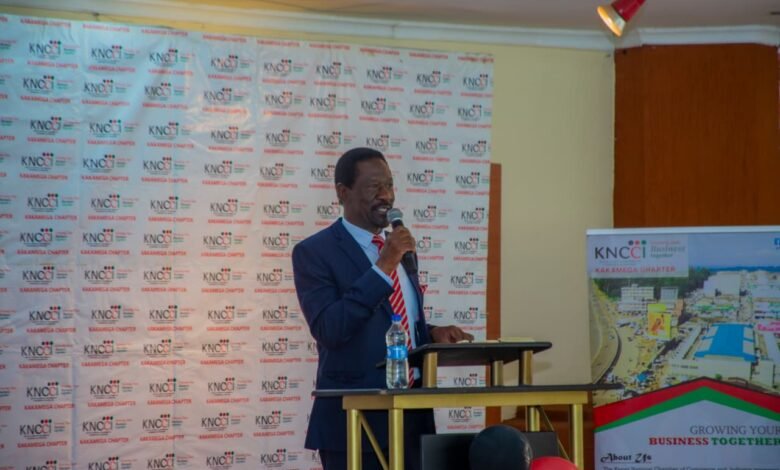
Kenya has witnessed a compelling shift in the credit market space, looking at the growing importance of Credit Reference Bureaus (CRBs) and the structural challenges that continue to hinder business growth in counties. This is according to Metropol Corporation Group Managing Director, Sam Omukoko, who spoke on Thursday during a Kenya National Chamber of Commerce and Industry (KNCCI) Kakamega Chapter forum.
Omukoko was joined by a panel of experts, including lawyers and financial consultants who guided local entrepreneurs on navigating high-risk operating environments.
The discussions explored legal compliance in real estate, proper management of employment and labour laws, and the critical role of CRBs in unlocking sustainable access to credit for businesses.
Metropol Corporation has built a solid footprint in the business information industry, operating four key businesses. The corporation runs a Credit Reference Bureau, licensed in Kenya and Uganda, and maintains credit histories used by lenders to evaluate creditworthiness.
The corporation also runs a credit rating agency, licensed in Kenya and Rwanda, that provides long-term credit analyses for businesses seeking financing. These ratings incorporate industry outlooks, management capability, and business structure. Metropol also supports companies across the region through Business Information Reports (BIR), which help them assess the credibility of customers both locally and internationally. Additionally, its debt collection services assist businesses in recovering money from customers who purchased on credit.
According to Omukoko, business financing always comes down to two avenues, including equity and debt. While equity involves savings and shareholders’ contributions, debt typically comes from lenders who expect repayment within defined timelines.
Thid even as he cautioned that businesses built too quickly on debt often struggle because lenders require repayment before the business has established steady cash flows.
“For borrowing to make financial sense, the interest charged must always be lower than the profit generated, otherwise, the cost of credit erodes business returns. Lenders therefore assess a borrower’s risk by asking whether the borrower can repay, whether repayment will be timely, whether the lender will earn a profit, and how the funds might be recovered in case of default,” said Omukoko.
When CRBs were first introduced, they were widely misunderstood because they only collected default information, creating the false perception that borrowers were being “blacklisted.” This changed in 2015 when the bureaus evolved to capture both negative and positive data.
“The goal of the bureau is not to isolate struggling borrowers but to build their capacity to borrow by presenting a complete view of their repayment history.”
Today, anyone with a national ID or a registered business automatically has a credit profile, which becomes the foundation for establishing access to credit, an element which forms the three elements CRBs offer.
Second, is the credit history generates a credit score which, from Metropol, ranges between 200 to 900, which determines how affordable a loan will be, as lenders are legally required to price loans based on risk.
Third is the loan terms, such as interest rates and repayment periods that are increasingly defined by the borrower’s credit score. As a result, borrowers now want to be listed in the CRB system because without a credit history, access to unsecured credit, especially through mobile platforms, is nearly impossible.
Also Read: Data Shows 88% of SACCOs Prefer Metropol CRB for Risk Mitigation
A borrower who consistently demonstrates good repayment behaviour can now negotiate better terms without presenting assets such as title deeds, shifting how lenders assess risk compared to the traditional dependence on collateral.
Omukoko said this behavioural lending model has opened the door for millions of Kenyans to access credit through mobile channels and other unsecured facilities.
“Access to credit is no longer primarily dictated by security but by the profitability of the business and the demonstrated reliability of the borrower.”
Despite these advancements, some regions continue to face unique challenges, with Omukoko singling out his home County, Kakamega.
He acknowledged the region which forms part of larger western Kenya, records the lowest levels of borrowing in the country.
Historically, residents have been hesitant to borrow due to fear of losing property in auctions. This has contributed to minimal borrowing and slightly higher default rates. Compounding the problem is capital flight, where money earned in the county is often spent on goods sourced from Nairobi or across the border in Uganda.
This, according to Omukoko, limits the internal circulation of capital that would otherwise support the growth of local businesses.
Although the county has a population of two million, it has fewer than 20,000 registered businesses, with Omukoko challenging the region to potentially shift from consumption to production.




Moto X3M — Stunt biking with lethal track design. Manage throttle, tilt mid-air, and stick precision landings. Challenge: gold-time every course—share your medals.