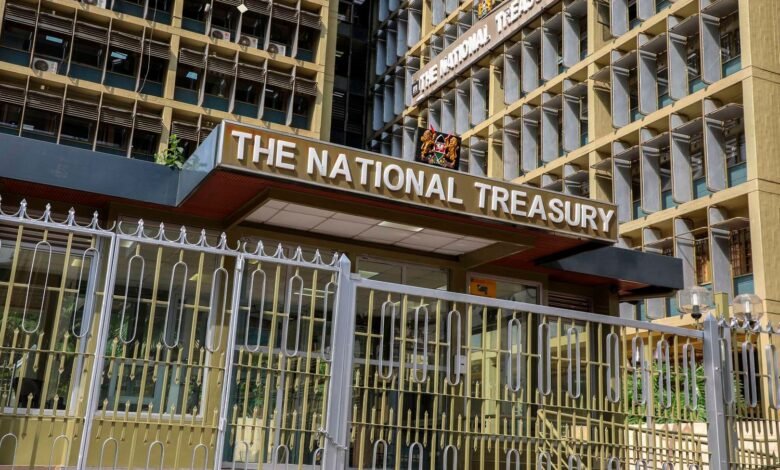
Kenya’s Draft 2026 Budget Policy Statement has signaled notable changes, pointing to a tighter but more pressured fiscal outlook.
While total expenditure for 2026/27 has been marginally reduced to Ksh.4,641.9 billion (22.0% of GDP), revenue projections have been revised down more sharply to Ksh.3,487.0 billion (16.7% of GDP), reflecting continued challenges in revenue mobilisation.
As a result, the fiscal deficit is widening to Ksh.1.1 trillion, equivalent to 5.3% of GDP, moving further away from the government’s medium-term target of below 4%.
To plug this gap, the Treasury plans to rely more heavily on domestic borrowing, which has been increased to Ksh.1 trillion, while external borrowing has been sharply cut to Ksh.99.5 billion, suggesting reduced access to or appetite for external financing.
The revenue strain is already evident in the current financial year, with the Exchequer missing its target by Ksh.107.5 billion in the first four months of 2025/26, largely due to weak ordinary revenue performance.
Kenya’s ambitious tax policies, intended to boost government revenue, have paradoxically contributed to persistent shortfalls, according to a recent analysis by the Parliamentary Budget Office (PBO).
The office, which provides technical advice to Parliament on fiscal matters, has highlighted that overtaxing citizens encourages evasion and avoidance, ultimately sabotaging collection targets.
Also Read: KRA falls short of revenue target to collect Ksh.1.56 trillion
In the current PBO, the government missed revenue goals by a staggering Ksh.342 billion over the past two financial years (2023/24 and 2024/25).
These shortfalls coincided with heightened public unrest triggered by controversial new tax proposals, including those in the withdrawn Finance Bill 2024. The core issue, as identified by the PBO, lies in overly optimistic tax projections set by the National Treasury.
These targets fail to account for economic realities and taxpayer behavior. When taxes become burdensome, individuals and businesses resort to evasion or avoidance strategies, reducing overall compliance and revenue inflow.
Revenue shortfalls reached a peak during the 2023/24 and 2024/25 fiscal years, exacerbated by aggressive tax measures.
For instance, in the previous financial year, the Treasury was forced to revise downward the Kenya Revenue Authority’s (KRA) targets from Ksh.2.9 trillion to Ksh.2.58 trillion after it became clear that goals were unattainable post the Finance Bill controversy.
The PBO has urged a fundamental rethink of Kenya’s taxation strategy and has recommended balancing revenue generation with incentives for investment to foster economic growth rather than stifling it.
Among the proposed reforms are:
-Full digital transformation of revenue administration.
-Upgrades to ICT infrastructure.
-Streamlined tax procedures.
-Improved data governance.
-Enhanced service delivery standards.
These changes, the report argues, would create a “more transparent, responsive, and efficient tax ecosystem” better suited to Kenya’s evolving economy.