Kenya has set food security as a strategic economic asset and a driver of national stability, investment confidence, and long-term growth, in what appears to be a plan for large-scale and commercial agriculture.
The sector has been ailing the country’s future generations, but now, the Kenya Kwanza administration has listed it among priorities under critical national infrastructure on par with energy, transport, and security systems.
Recent initiatives in the sector have exceeded Ksh.34 billion in partnerships with the International Fund for Agricultural Development (IFAD) for sustainable, climate-smart agriculture.
These efforts target over 2 million people, focusing on improving irrigation, enhancing, and strengthening agricultural resilience through debt-for-food swaps.
“Food security is recognised as an integral component of that mandate, because a well-fed nation is a secure nation,” said Dr Raymond Omollo, Principal Secretary in the State Department for Internal Security and National Administration.
PPP Structure in Food Security
At the centre of this strategy is the revitalisation of the Galana Kulalu Food Security Project, which was widely considered a “ghost project,” or a “white elephant” between approximately 2019 and 2022.
It is now structured under a Public–Private Partnership (PPP) framework.
The project is designed to irrigate 1.5 million acres for large-scale farming in Kilifi and Tana River counties. It is undergoing a revival with significant investment, including a Ksh.12.5 billion injection from private partner SELU Limited.
Also Read: Kenya’s Agriculture Sector Records Ksh.1.7 Trillion Growth in 2024
The model is designed to mobilise private capital, agribusiness investors, technology providers, and logistics partners into large-scale commercial food production.
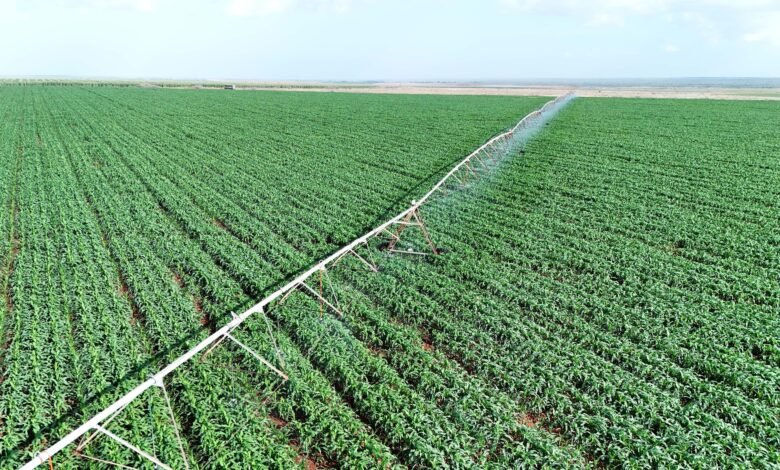
The project integrates fertigation systems, a process of the application of water-soluble fertilisers through irrigation, supported by advanced centre pivot irrigation infrastructure.
Currently, nine pivot systems are operational, with expansion plans to reach 23 pivots, initially covering 3,000 acres.
The economic viability of the project was reinforced by President William Ruto on October 11, 2025.
The production benchmark at the project upon the President’s visitation was that the first harvest would be on a 330 acres with a yield projection of 28 to 30 bags per acre.
So far, 1,500 acres have already been planted, and a further 1,700 acres are scheduled for cultivation, raising the total acreage to 5,400.
The project currently supports the cultivation of high-demand crops, including maize, onions, and cassava, positioning it as a multi-crop commercial farming hub.
Expansion Pipeline
For some time now, the project has faced challenges like water supply. The expansion pipeline is dependent on the construction of the Galana-Kulalu Dam, estimated to cost Ksh.40 billion.
Its completion would, along the way, witness the cultivation of land stretching as far as 6,400 acres mid mid-year 2026.
President Ruto is also inclined to see it scale up to 20,000 acres in the initial commercial phase.
The project is expected to cut Kenya’s food import dependence by up to 40%, delivering macroeconomic gains, including Reduced foreign exchange pressure, lower national import bills, strengthened agricultural export capacity, expansion of agro-processing industries and job creation across farming, logistics, storage, and value chains.