

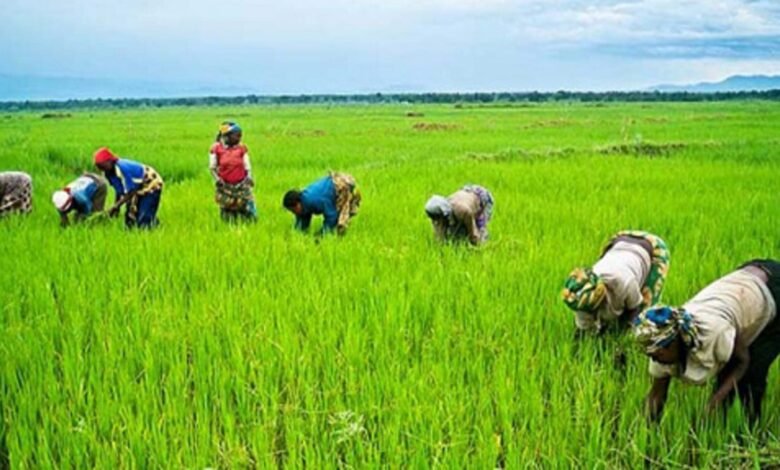
The government has confirmed that all pending payments owed to Mwea rice farmers have been cleared.
Anthony Waweru, Managing Director of the Mwea Rice Growers Multipurpose Co-operative Society (MRGM), said the payments were made as agreed between farmers and the Kenya National Trading Corporation (KNTC).
Waweru said the cooperative carried forward less than one percent of unpaid stock from 2025 into 2026, compared to nearly 30 percent the previous year. As of December 31, KNTC had paid for all rice delivered and is ready to continue buying all the rice farmers supply.
He spoke during a visit to the cooperative by senior government officials led by Agriculture and Food Authority (AFA) Director General Dr. Bruno Linyiru.
Others present included Acting Agriculture Secretary Peter Owoko, National Cereals and Produce Board Managing Director Samuel Ndung’u Karogoh, AFA Director of Crops Calistus Kundu, and KNTC Managing Director Lucy Anangwe.
Founded in 1964, MRGM is the oldest and largest rice cooperative in Kenya. It represents farmers in the Mwea Irrigation Scheme, which produces about 65 percent of the country’s rice.
The cooperative also dismissed claims that rice imports are hurting local farmers.
Also Read: Duty Free Sugar Market After 24 Years: A New Era for Production, Prices and Regional Trade
Mwea Pishori rice targets a premium market and does not directly compete with imported rice. Imported rice sells at Ksh.80–100 per kilogram, while Mwea Pishori sells at Sh140–160 per kilogram.
Rice farming in Kenya happens in two irrigated seasons and one rain-fed season, with the main irrigated season running from planting in January–February to harvesting in June–August, especially in Mwea, Ahero, West Kano, Bunyala, and Perkerra.
A second irrigated crop is harvested in November–December, while rain-fed rice depends on seasonal rains.
Kenya produced 123,916 metric tonnes of milled rice in 2022, rising to 169,291 metric tonnes in 2024.
In 2026, paddy production is projected to reach 302,000 metric tonnes, equal to about 181,200 metric tonnes of milled rice, showing strong growth in the sector.
