

It seems the sky is falling on the aid system and umbrellas are few and far between. A simple Google search exposes article upon article detailing donor countries slashing aid budgets or statistics that indicate how much trouble we are in as a global society, and just how much it will cost for us to be able to save each other.
The full human cost of the Official Development Assistance (ODA) cuts is not yet known, but estimates are harrowing. For instance, a study conducted by the Barcelona Institute for Global Health, published in The Lancet Global Health, estimates that severe cuts to ODA could result in 22.6 million additional deaths across 93 low- and middle-income countries by 2030 — this includes over 5 million children under the age of five. The study also indicated that ODA was associated with significant reductions in global health-related mortality between 2002 and 2021, including a 39% reduction in under-five mortality.
Put simply, and somewhat unoriginally: we’re in crisis.
Usually when crises hit, it’s expected for us to be in immediate response mode, but this is different. When it comes to the ODA funding cuts, the world is not sure how to respond. The ideas are there, but the direction isn’t. That is to say, there is no universally agreed upon response to aid’s funds being cut.
It seemed that, in the early 2000s, and particularly around the Make Poverty History campaign, there was a clear collective understanding that aid could have a substantial positive impact. Though critics of aid and the campaign existed, there was a strong political consensus around the need to increase aid funding and tackle global poverty.
As the years progressed, however, opinion on global aid began to fracture for various reasons. Leading us to where we are now — with the knowledge that without aid, millions of people will die and multiple systems will cease to exist. Yet we are also completely aware that the aid system faces its fair share of issues, and unsure about what aid should continue to look like in an age where public trust in aid is in a rocky state.
In mainstream media, conversations on aid and its cuts often take two routes: the first is a focus on the numbers, turning a largely human issue into a series of statistics and figures to better communicate an analytical understanding of what cut budgets means right now, and what it could mean for the future. The second is zooming in on specific beneficiaries of ODA, and drawing sympathy from the situation they now find themselves in, through no fault of their own. Both routes are necessary parts of the conversation. But both tend to leave us with the same question: “Where do we go next?”
The grassroots feels like the best answer.
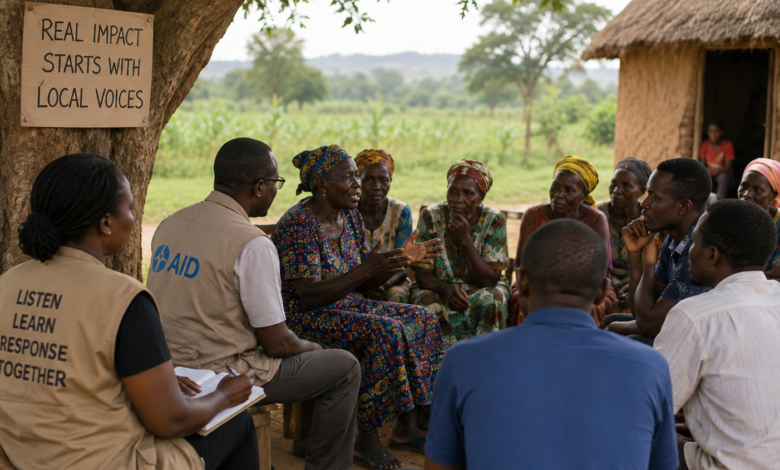
A great deal of conversation is still happening among donor governments and institutions about how to make less money go further, rather than asking countries and communities receiving aid, particularly practitioners of aid, what ODA can look like in the incoming future. Why not involve the very people experiencing the issue in conversations about their lives and futures? It’s not unimaginable that those very people could themselves hold the keys to a solution. It’s worked before.
In South Africa in the late 1990s and early 2000s, people living with HIV and grassroots activists organised around the South African government’s failure to make lifesaving treatment widely accessible, despite growing evidence of its effectiveness. It started with listening to those affected by a lack of treatment, who were able to articulate what needed to change and suggest how that change could come about. This was the Treatment Action Campaign (TAC), whose success in influencing policy was rooted in the voices and experiences of those most affected by the lack of treatment. This organising and listening, combined with advocacy and resources, ultimately contributed to policy change, including a Constitutional Court order requiring the government to remove restrictions on access to treatment.
In Brazil in the late 1980s, the city of Porto Alegre faced a familiar problem: decisions about public spending were largely made without meaningful input from the communities whose lives those decisions affected. In response, the city introduced participatory budgeting, giving residents a direct role in voicing their communities’ needs and influencing how municipal resources were allocated. Communities identified basic services such as water and sanitation as priorities, particularly in lower-income areas. Over time, the process contributed to significant improvements in access to these services and a greater share of public investment being directed towards lower-income communities. Porto Alegre became an pioneering example of what can happen when governments listen to communities and give them influence over the resources intended to serve them.
The challenge, of course, is creating spaces where this kind of listening can actually happen. However, as the world has come to connect online, there are more opportunities than ever to connect people with different experiences of aid into the same conversation. Platforms like Kuja — a platform that connects grassroots and local civil society organisations in the Global South with global resources, donors and funding opportunities — can help create those spaces by providing forums for people to exchange ideas and shape conversations about the future of development.
Listening isn’t magic. But when listening is connected to power and resources, it can lead to real action. What’s needed as we consider the future of aid is deliberate listening to those on the grassroots; and a willingness from aid practitioners, donors and others within the system to engage with what they hear. Listening can be made easier with access to online resources like Kuja as the platform hosts discussion forums where grassroots actors and aid practitioners can share perspectives with each other. There’s one on there right now about the future of aid, and anyone working in the aid sector in the Global South can contribute to the conversation after signing up to join the platform.
Now’s the time to listen and further the conversation on the future of aid, bring unheard voices into the room in order to give ourselves the best chance at an effective and sustainable solution to the sky falling.
