

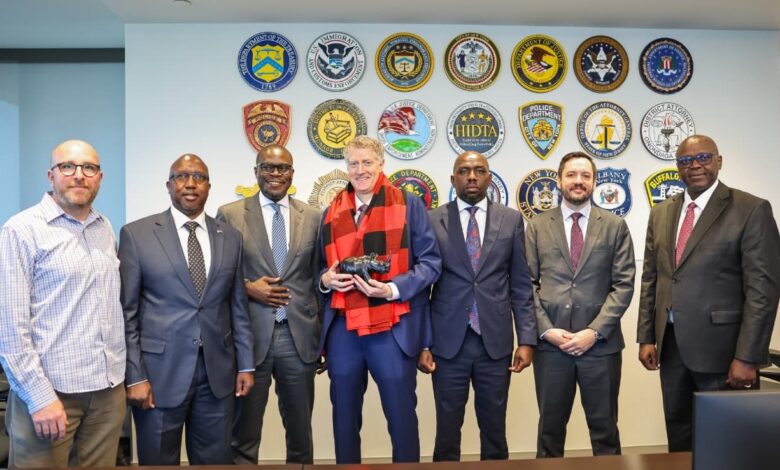
Kenya will soon have a New York Police Department replica in Nairobi, as the Interior Cabinet Secretary Kipchumba Murkomen seeks to beef up security in Nairobi.
This was revealed when the CS visited one of the world’s busiest cities on June 3, 2026, flanked by several government officials, including Nairobi Governor Johnson Sakaja.
The motive behind the replica is an Intelligence-led, data-driven policing and strong multi-agency cooperation that has been witnessed at the NYPD.
It will see the birth of the Nairobi Metropolitan Police Unit, “which will serve as a pilot model for specialised metropolitan policing in Kenya, will enhance information sharing among agencies and leverage real-time intelligence to prevent and respond swiftly to crime,” according to the CS.
Governor Sakaja, among other officials, were particularly impressed by the NYPD’s utilization of real-time data and information synthesis, which facilitates enhanced decision-making and the strategic deployment of personnel.
Central to these operations is the Real-Time Crime Center, a sophisticated command hub that integrates data from surveillance systems, emergency communications, field reports, and criminal records to facilitate immediate responses to ongoing incidents.
Nairobi indeed requires standard metropolitan vigilance, with common urban crimes like pickpocketing, bag-snatching, and vehicle break-ins.
While major business hubs and gated areas are well-policed and secure, travelers and locals should avoid walking alone at night, stay highly alert in crowded areas, and arrange safe, reputable transportation.
Also Read: Kenyans Mark first Anniversary of Deadly Protests Amid Fresh Outrage Over Police Conduct
The actualization of this ambitious tech-intensive exercise will be dependent on enough resource allocation by the state.
National Police Budget Allocation
In the fiscal year 2026/27, the Kenyan government has increased budget allocation to the National Police Service by Ksh.12.4 billion to Ksh.147.4 billion.
The revised figure reflects interventions from parliamentary oversight committees to scale up operational readiness, including Equipment Modernisation, which has been allocated Ksh.800 million.
This is designed for purchasing new police helicopters, alongside KSh 200 million earmarked to overhaul grounded aircraft.
And as the country gears up for the General Election in August 2027, and in readiness to that effect, an additional operational funding has been channeled into the service to reinforce nationwide security, intelligence, and response logistics.
About Ksh.1.9 billion has been allocated strictly to VIP protection and safeguarding government facilities, managed under the Critical Infrastructure Protection Unit (CIPU).
It, however, remains to be seen if the benchmarking will materialise, given the intensity, policies and laws that come with implementing such initiatives.
